
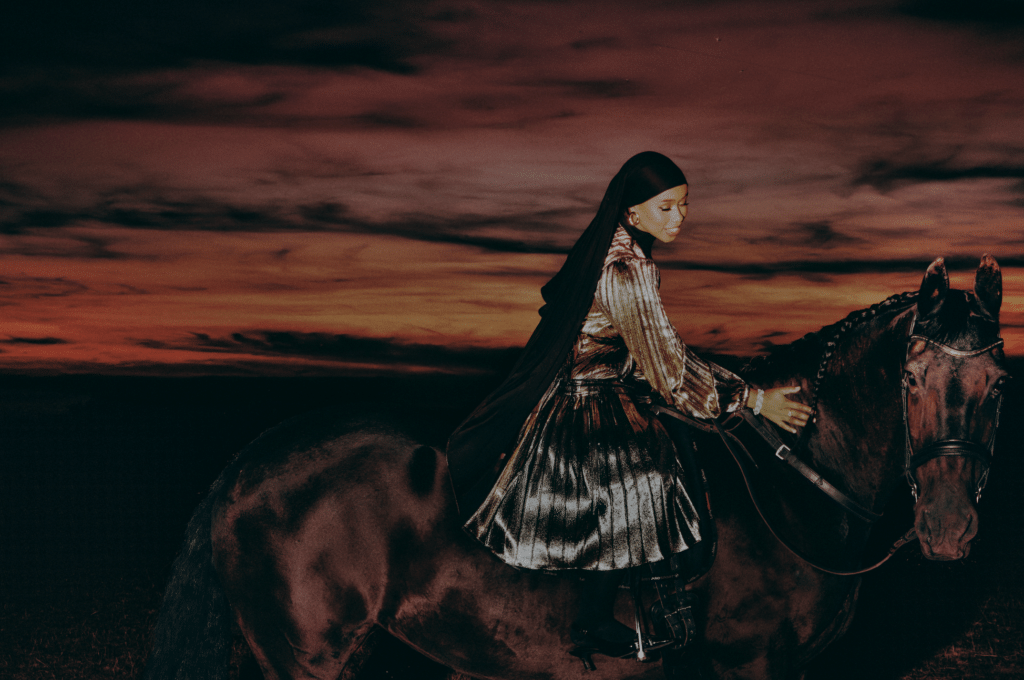
Six years after making history at Goodwood, khadijah, Britain’s first hijab-wearing jockey, is working to build a lasting career.
The sport still has some catching up to do.
There’s a version of Khadijah Mellah’s story that’s been told a hundred times: Peckham girl, mosque leaflet, Magnolia Cup, history made. It’s all true. But sit with her for just 20 minutes – mid–commute, phone cutting in and out, training schedule pulling her in three directions at once – and a different story starts to surface underneath.
Khadijah grew up in Peckham with a ‘weird divine obsession’ about animals and horses.
Riding lessons cost £30 to £40 per session, which her parents could not afford. So she accepted that it wasn’t going to happen.
Then her mum found a leaflet at a mosque in Brixton for the Ebony Horse Club.
I thought it was just a theatre-inspired group or something, she says.
I was in disbelief when we visited; I thought, ‘Oh my God, this is real’. She was hooked and asked to join, though she was too young. The founder made an exception for her and her siblings. After two years on the waiting list, she finally got in. She stayed for almost a decade.

“I was part of the Ebony Horse Club tapestry for about eight, maybe nine years, khadijah, she says.”
She volunteered on extra days, took part in every activity she could.
Later, she worked her way up quickly.
She had never ridden a racehorse until a few months before the Magnolia Cup.
The Magnolia Cup is an annual charity race for amateur female riders at Goodwood. At the same time, she was studying for her A-Levels. Ramadan fell in the middle of it all.
“It was extremely intense,” she says.
She would study until 11 pm. Early, she would get up early for circuit training. She went to school and trained in the gym during lunch breaks. Her school made an exception so she could use the gym without supervision. She was fasting too.
“I replaced food with a heavy gym session,” she says.
In 2019, she crossed the finish line first at Glorious Goodwood. She became the first person in Britain to win a race wearing a hijab. What she remembers most is not the triumph, but the relief.
“I was 18,” she says.
I think I was just a bit unaware of the gravity of what I was getting myself into. Khadijah remembers the moment with mixed feelings.
“To me it was just another goal I wanted to achieve. I didn’t realise people would care about my journey.”
What stayed with her was the parade ring and the feeling that she hadn’t let anyone down.
For months she’d been falling off, getting injured and hearing that she wouldn’t be any good.


She’d had just three and a half, maybe four months, to learn what she calls an extremely skilled sport.
Winning was less important than the relief.
Moreover, it changed my life massively, forever.
Khadijah has said she does not want to be treated as a token, valued for being first.
Six years on, racing still hasn’t changed.
For three years she has worked toward a senior Category A jockey licence.
But bookings as an amateur remain rare.
I thought I’d be better received, she says.
I think racing is happy to have a one-off story of diversity to show progress.
Nevertheless, carrying that diversity through the ranks is slower.
She’s not bitter, she says, just realistic. She points to young jockeys she’s mentored who are now winning races. “I may have to come to terms with accepting that I had to walk for others to run. It is a reality I must face.” Most of her support comes from outside racing. “There are select individuals that have independently carried me, and I can name them on three fingers.”
She says the industry is unstable and pulled in different directions, and her own career isn’t a priority. “I’m not bringing in ownership or funding, so to them, right now, I’m not a massive priority.”
Brands are finally showing interest in Khadijah’s journey.
To read the full interview, subscribe to our next issue HERE